
In brief
A drone attack in Khartoum, Sudan, struck near the international airport, a day before it was set to resume domestic flights after a prolonged shutdown due to ongoing warfare. Residents reported hearing explosions, yet details on casualties are scarce. The incident marks the third attack in the capital within a week amid deteriorating safety conditions as the conflict between the army and the Rapid Support Forces continues, leading to a worsening humanitarian crisis.
A drone attack has hit an area near the international airport in Sudan's capital, Khartoum, a day before it was set to resume domestic flights for the first time since war broke out in 2023.
Residents of the city reported hearing explosions in several districts early on Tuesday morning. Social media images - yet to be verified by the BBC - appear to show a series of blasts.
There is no information on casualties or damage, and no-one has claimed responsibility.
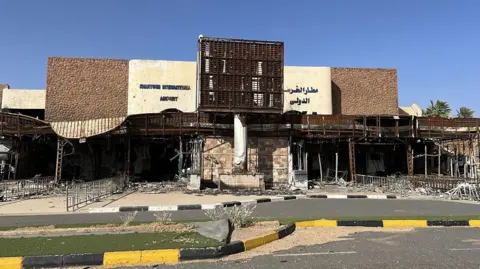
On Monday, Sudan's Civil Aviation Authority had announced the airport would reopen on Wednesday, months after the army recaptured Khartoum from the Rapid Support Forces (RSF) and began repairing the heavily damaged airport.
Tuesday's strike marked the third attack in the capital within a week, following strikes on two army bases in north-west Khartoum on consecutive days last week.
The Sudan Tribune news website cites a security source as saying that anti-aircraft defences had intercepted several drones after 04:00 local time (02:00 GMT) but gave no details on any damage.
The international airport shut down shortly after fighting erupted between the army and the RSF in April 2023, when the paramilitary force took control of it.
Port Sudan, in the east, has the country's only functioning international airport, although it has been targeted by drones.
Khartoum has remained relatively calm since the army retook control of the city in March, but attacks have persisted, with the RSF accused of targeting civilian and military infrastructure from a distance.
Since the loss of the capital, the RSF has intensified efforts to capture el-Fasher - the army's last stronghold in the western Darfur region.
The ongoing conflict has killed tens of thousands and forced millions from their homes.
What started as power struggle between the army and the RSF has since drawn in other Sudanese armed groups and foreign backers, plunging the country into what the UN calls the world's worst humanitarian crisis.