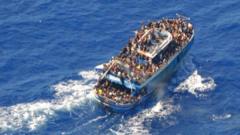
Audio clips leaked from a Greek rescue coordination center have surfaced, challenging the official narrative surrounding a tragic shipwreck in the Mediterranean that resulted in the presumed deaths of up to 650 migrants. The boat, named Adriana, sank in international waters near Greece’s search-and-rescue zone on June 14, 2023, after departing from Libya.
Multiple survivors have alleged that Greek coastguards directly contributed to the capsizing of their overcrowded fishing vessel during a failed towing attempt. They also claimed there was intimidation and attempts to silence witnesses. Despite these assertions, the Greek coastguard maintains that no rescue attempt was necessary as the vessel was not in distress, insisting that it was heading towards Italy voluntarily and did not wish to enter Greek waters.
The leaked audio features conversations from within the Joint Rescue Coordination Centre (JRCC) in Piraeus, revealing orders to instruct the captain of the migrant boat to deny a desire to reach Greece. In one exchange, an officer tells the captain to inform an approaching vessel that the migrants did not want to go to Greece but rather to Italy. These instructions come in stark contrast to the coastguard's public statements.
The disaster marks one of the most severe migrant crises in the Mediterranean, with estimates suggesting as many as 750 individuals were on board when the boat departed from Tobruk, Libya. As of now, about 82 bodies have been recovered, while the United Nations continues to estimate that around 500 individuals, including vulnerable women and children, may still be unaccounted for.
In subsequent communications, it was reiterated that the migrants aboard had expressed a preference for reaching Italy. An accompanying vessel, the Lucky Sailor, confirmed that cries for Italy were heard loud and clear from those on the Adriana.
The Greek coastguard has so far refrained from commenting on the authenticity of the leaked recordings, stating it has provided all evidence to the relevant Maritime Court for investigation. The agency boasts of having rescued over 250,000 people over the last decade and emphasizes its commitment to humanitarian missions.
However, skepticism remains, especially after an earlier investigation revealed movement patterns indicating the Adriana had drifted for several hours without making progress toward safety. Previous attempts at legal accountability were quashed when nine Egyptian nationals faced charges related to the disaster, only for the court to determine that it lacked jurisdiction since the incident occurred in international waters.
Human rights advocates highlight a troubling pattern of behavior from Greek authorities regarding treatment and rescue of migrants, with calls for thorough international scrutiny now intensifying. The Greek Ombudsman and the Naval Court are currently reviewing the allegations of misconduct and discrepancies involving the coastguard's actions.
As the investigation unfolds, the world watches closely, hoping for justice for those who have tragically lost their lives in the Mediterranean’s perilous waters.