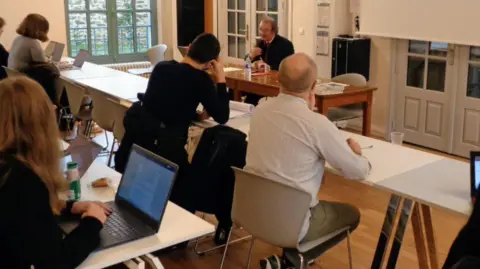
University professor Xavier Crettiez admits that he doesn't know the real names of many of the students on his course. This is a highly unusual state of affairs in the world of academia, but Prof Crettiez's work is far from standard.
Instead, he helps train France's spies.
I rarely know the intelligence agents' backgrounds when they are sent on the course, and I doubt the names I'm given are genuine anyway, he says.
If you wanted to create a setting for a spy school, then the campus of Sciences Po Saint-Germain on the outskirts of Paris seems a good fit. With dour, even gloomy-looking, early 20th Century buildings surrounded by busy, drab roads and large, intimidating metal gates, it has a very discreet feel.
Where it does stand out is its unique diploma that brings together more typical students in their early 20s, and active members of the French secret services, usually between the ages of 35 and 50.
The course is called Diplôme sur le Renseignement et les Menaces Globales, which translates as Diploma of Intelligence and Global Threats. It was developed by the university in association with the Academie du Renseignement, the training arm of the French secret services.
This came following a request from French authorities a decade ago. After the 2015 terrorist attacks in Paris, the government went on a large recruitment drive within the French intelligence agencies, asking Sciences Po to create a new course to both train potential spies and provide continuous training for current agents.
Large French companies were also quick to show interest, both in getting their security staff onto the course, and snapping up many of the younger graduates.
The diploma consists of 120 hours of classwork spread over four months. For external students – the spies and those on placement from businesses – it costs around €5,000 ($5,900; £4,400).
The core aim of the course is to identify threats wherever they are, and how to track and overcome them. Key topics include the economics of organized crime, Islamic jihadism, business intelligence gathering, and political violence.
To attend one of the classes and speak to the students, I had to be vetted by the French security services. The theme of the lesson was intelligence and over-reliance on technology.
One of the students I spoke to is a man in his 40s who goes by the name Roger. He told me in clipped English that he is an investment banker, providing consultancy across West Africa. He joined the course to provide risk assessments to his clients there.
Professor Crettiez notes that there has been a huge expansion in the French secret services in recent years, totaling around 20,000 agents, with agencies like the DGSE and DGSI taking center stage.
Yet, the focus extends beyond terrorism to money laundering and the surge in mafia activity, particularly concerning public and private sector corruption driven by drug trafficking profits.
The interest from the private sector in the diploma continues to grow, with leading companies in defense and aerospace looking to hire its graduates, who are well-equipped to deal with ongoing cybersecurity and sabotage threats.
This year, 28 students are enrolled in the class, including six spies, easily identifiable by their discreet demeanor during breaks. With arms crossed, many express that the course serves as a ladder for promotions, while others cherish the fresh perspectives gained from the academic environment. For instance, student Alexandre Hubert expressed a desire to understand the economic rivalry with China better, moving away from the glamorization of espionage found in fiction.
Interestingly, nearly half of the students are women. This trend has been observed recently, as more women show interest in intelligence work, contributing to a sense of patriotic duty that has evolved over the last two decades.
However, Prof Crettiez remains cautious, often receiving applications from attractive candidates with extraordinary qualifications that are promptly dismissed, hinting at the undercover atmosphere of the program.
He clarifies that while these courses may evoke images of action-spy films, the reality is that most intelligence jobs are desk-bound. The right balance of unexpected elements and student experiences at Sciences Po Saint-Germain ensures that the future of France's secret services remains robust and adaptable.