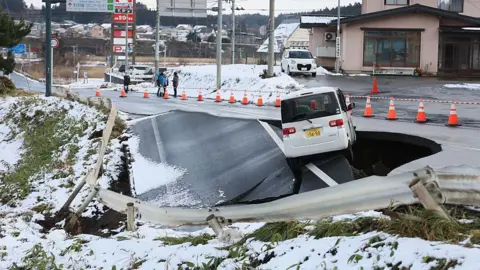
After a magnitude 7.5 earthquake struck north-eastern Japan on Monday, authorities again warned of the possibility of a future megaquake. It means that thoughts in Japan are turning to the 'big one' - a once-in-a-century quake.
In September, Japan's earthquake investigation panel said there was a 60-90% chance that a megaquake would occur in the Nankai Trough - an area of seismic activity which stretches along Japan's Pacific coast - within the next 30 years.
In April, authorities had warned that a megaquake had the potential to trigger a tsunami of more than 20m (66ft) which could hit parts of Tokyo and other prefectures. They predicted that there would be around 300,000 deaths and trillions of dollars in economic damage.
Officials urged residents in seven prefectures from Hokkaido in the north to Chiba in central Japan to stay on high alert for a potential megaquake. This is a vast area with millions of people.
A government official said there was a possibility that a large-scale earthquake with a magnitude of 8 or higher could occur as a follow-up earthquake.
Japan's director for disaster management stated that global earthquake data suggests there's a possibility, not a prediction, of a larger tremor to come.
However, an evacuation order was not issued, and officials mentioned the probability of a larger quake occurring is about one in 100.
The last megaquake recorded along the Nankai Trough occurred almost 80 years ago, with these events generally striking every hundred years or so.
Seismologist Robert Geller asserts that while the likelihood of more earthquakes is higher than usual, it does not confirm a major quake is imminent, pointing to the inherent unpredictability in earthquake forecasting.