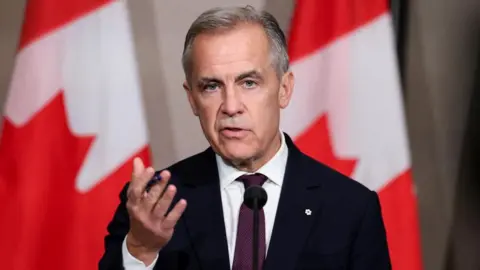
Prime Minister Mark Carney is set to present his government's first federal budget on Tuesday, and has warned Canadians to expect 'sacrifices' as he aims to transform an economy battered by US President Donald Trump's tariffs.
Carney has said the spending plan will see both significant cuts and 'generational investments' to strengthen the economy and reduce the country's reliance on US trade.
The plan is also expected to lay out how Canada will pay for billions of dollars in defence spending to fulfil the new NATO commitment to spend 5% of GDP on defence by 2035.
Analysts have suggested the federal deficit could exceed C$70 billion ($50 billion; £38 billion), up from $51.7 billion last year.
The fiscal plan is seen as a major test for Carney, a former central banker for Canada and the UK who has promised to make Canada's economy the strongest in the G7 group of wealthy nations.
'We used to take big, bold risks in this country. It is time to swing for the fences again,' he said in a pre-budget speech last month.
Canada, which trades primarily with the US, has a particular exposure to tariff shocks.
Carney has said he is setting a goal for the country to double its non-US exports in the next decade.
Joy Nott, a partner at KPMG Canada who focuses on trade and customs, told the BBC that 'Canadian companies need government support during the transition of moving from one market to another.'
That includes everything from finding money to travel on trade missions abroad to market research and navigating regulatory approvals when entering new markets.
Finance Minister Francois-Philippe Champagne underscored the 'made-at-home' message as he bought new shoes at a Quebec business, which he called ‘emblematic of who we are as a nation.’
'We're moving from reliance to resilience, from uncertainty to prosperity, we're going to do the kind of things that make this country stronger,' Champagne said.
While focusing on 'investments,' Carney has also promised to balance the federal operating budget over the next three years.
This summer, federal ministries were asked to find ways to cut up to 15% from programme spending in the coming years to fund spending into areas like trade infrastructure, housing, and tariff-impacted industries.
It is still unclear where Carney's Liberal Party will find the support they need to pass the spending package. The Liberals, three seats short of a majority, require at least one other party's help to pass the fiscal plan.
Canada faces a potential snap election if the budget vote, which is a confidence vote, fails, though this situation seems unlikely given the recent elections.
'I don't think any of the other parties want to run an election right now,' said Elizabeth McCallion, a political science professor at the University of Toronto.
The most likely support would come from the left-wing NDP, currently in a leadership race following a disappointing election performance in April.
Political wrangling could emerge regarding expected austerity measures, with concerns growing over the impact of Trump's tariffs on Canadian imports.
With unemployment increasing, the Bank of Canada anticipates a GDP growth of 1.2% in 2025, 1.1% in 2026, and 1.6% in 2027.