In brief
Researchers have unveiled findings on the Hektoria Glacier's rapid retreat, which saw more than 8km of retreat in just two months late in 2022. This behavior gives rise to discussions on potential implications for sea level rise, but other scientists question the findings regarding the glacier's behavior and grounding position, indicating a divide in understanding this phenomenon.
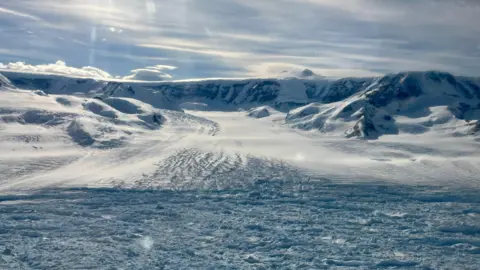
A recent study has brought to light the rapid retreat of the Hektoria Glacier in Antarctica, which diminished over 8km (5 miles) in just two months during late 2022. This phenomenon has left scientists questioning the underlying causes, with the authors suggesting that it may be the first documented case of a glacier front rapidly destabilizing while resting on the seabed.
Such changes could lead to significant sea-level rise if similar occurrences happen throughout Antarctica. Contrarily, some scientists claim that the glacier was floating, rendering the recent changes less unusual.
Notably, Hektoria has already retreated roughly 25km (16 miles) between January 2022 and March 2023, a fact that raises alarm about potential implications for global sea levels, especially if other glaciers undergo similar destabilization.
Study lead author Naomi Ochwat likened the research into Hektoria's retreat to a 'whodunnit' mystery. She recounts that this turn of events may be attributable to an ice plain, a flat section of bedrock, under the glacier, facilitating rapid movement and calving processes of icebergs.
Despite the startling nature of the findings, there is considerable debate over the actual grounding position of the glacier, which could alter interpretations of its retreat. Critics, including glaciologist Dr. Frazer Christie, argue that uncertainty about the grounding line’s location remains a crucial factor in determining the unusual nature of the glacier's retreat.
Certainly, researchers agree that the changes occurring in the Antarctic are alarming, with some asserting that adaptation to these rapid transitions is necessary to better monitor future responses in this sensitive ecosystem.