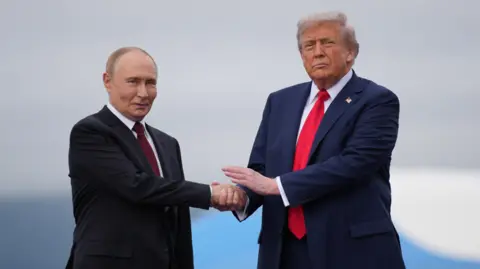
Russia has welcomed US President Donald Trump's new National Security Strategy, calling it largely consistent with Moscow's vision.
The 33-page document, unveiled by the US administration this week, suggests Europe is facing civilisational erasure and does not cast Russia as a threat to the US.
Combatting foreign influence, ending mass migration, and rejecting the EU's perceived practice of censorship are mentioned as other priorities in the report.
Several EU officials and analysts had pushed back on the strategy, questioning its focus on freedom of expression and likening it to language used by the Kremlin.
Kremlin spokesperson Dmitry Peskov remarked, The adjustments we're seeing... are largely consistent with our vision, during an interview with Russia's state news agency Tass.
Peskov described the strategy as a positive step, while emphasizing that Moscow would thoroughly analyze the document before making definitive conclusions.
The strategy appears to adopt a softer stance towards Russia, raising concerns among EU officials regarding its potential impact on efforts to end the war in Ukraine. The document also attributes the blame to the EU for disrupting US attempts to facilitate peace in the region.
In its assertions, the strategy emphasizes the need for the US to re-establish strategic stability to Russia and stabilizing European economies. This includes an endorsement of influencing policies across Europe, noting US priorities to combat prevailing trajectories in European nations.
The report additionally calls for a restoration of Western identity, alarming observers by stating Europe could become unrecognizable in 20 years or less, as socio-economic issues are overshadowed by threats of civilisational collapse.
The strategy further criticizes the reliability of NATO allies, suggesting some may lack the necessary economic and military strength moving forward.
Notably, the document praises the rise of patriotic European parties and encourages allies in Europe to foster a reconnection with this spirit.
As EU representatives engage in discussions with the Trump administration regarding a peace deal in Ukraine, lingering questions about the US position surface. German Foreign Minister Johann Wadephul mentioned, The US will remain our most important ally in the [Nato] alliance. However, issues of freedom of expression do not belong [in the strategy].
Meanwhile, Polish Prime Minister Donald Tusk emphasized Europe's alignment with the US in a social media post, asserting, Europe is your closest ally, not your problem. This is the only reasonable strategy for our common security.
On the contrary, former Swedish Prime Minister Carl Bildt criticized the strategy for its far-right inclinations.
The document asserts an America First approach, suggesting military action against drug trafficking in the Caribbean and a call for increased defense spending from Japan, South Korea, Australia, and Taiwan.
Democratic leaders in Congress expressed concern that this approach could jeopardize US foreign relations, with Representative Jason Crow labeling the strategy as catastrophic for America's global standing and New York Representative Gregory Meeks criticizing its departure from long-standing value-driven US leadership.