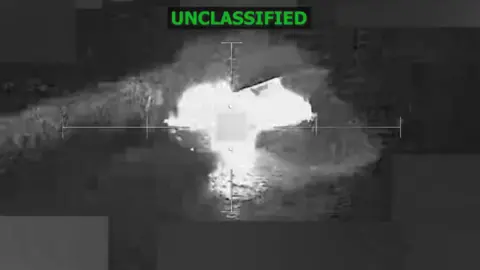
US airstrikes against alleged drug boats in the Caribbean and eastern Pacific have continued unabated since early September - a deadly campaign now dubbed Operation Southern Spear. Tens of thousands of troops and substantial air and naval assets have been deployed to the region, collectively forming the largest US military presence in and around Latin America in decades. On Sunday the US military confirmed the world's largest aircraft carrier, the USS Gerald R Ford, had arrived in the Caribbean.
The Trump administration argues the strikes are necessary to stem the flow of drugs to the US. They have, however, been controversial and sparked fears of a wider conflict in the region.
Why is the US conducting strikes?
President Trump and members of his administration have justified the strikes as a necessary counter-drug measure to stem the flow of narcotics from Latin America to US streets. In a statement, Defence Secretary Pete Hegseth said that the campaign - which on 13 November was officially named Operation Southern Spear - is aimed at removing 'narco-terrorists from our hemisphere' and securing the US from 'the drugs that are killing our people.'
But little information about the targets or what drug trafficking organisations they allegedly belonged to has been officially released by the Pentagon. In at least a few cases, Hegseth and several other officials have claimed that the targets were tied to Tren de Aragua, a Venezuelan gang designated as a foreign terrorist organisation by the Trump administration at the start of the year.
Where are US military units?
The US has deployed substantial strike power in the Caribbean and western Atlantic within striking distance of Venezuela. BBC Verify has identified 15 warships in the region based on ship-tracking data, satellite imagery and announcements by US authorities. This includes the USS Gerald R Ford aircraft carrier, described by the US Navy as 'the most capable, adaptable, and lethal combat platform in the world.'
How many strikes have there been?
Between 2 September and 16 November, US forces hit at least 22 vessels in 21 separate strikes in international waters, both in the Caribbean and in the eastern Pacific. The majority of these strikes have taken place off the coasts of Venezuela and Colombia. US Southern Command announced on Sunday that its latest strike, conducted on Saturday in eastern Pacific international waters, killed three 'male narco-terrorists' on board.
Are these boat strikes legal?
The Trump administration has insisted that the strikes are legal, justifying them as a necessary self-defence measure aimed at saving American lives. However, some legal experts have raised concerns that the strikes could be illegal and violate international law.
Is the US preparing to attack Venezuela?
The build-up has prompted concerns that the US is preparing to directly target Venezuela, or potentially to try to topple the left-wing socialist government of President Nicolás Maduro. On 3 November, Trump downplayed the possibility of a war with Venezuela, dismissing the notion while also expressing skepticism about Maduro's tenure in power.
How has Maduro responded?
The Maduro government has accused the US of stoking tensions in the region, announcing military exercises in response to the US actions. Maduro has called for peace and criticized perceived aggression from the US.