In brief
Venezuela condemned the United States for what it termed the 'greatest extortion' during an emergency session at the UN Security Council, following the US seizure of two Venezuelan oil tankers. Ambassador Samuel Moncada characterized the actions as worse than piracy and accused the US of violating international law. The US has committed significant military resources to block Venezuelan oil, claiming to combat drug trafficking and organized crime linked to the Maduro regime. The international community, including Russia and China, has criticized the US tactics, calling for an end to the aggression.
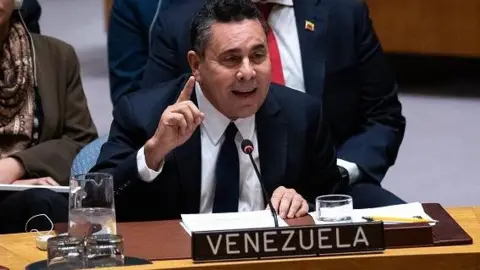
Venezuela has accused the United States of the 'greatest extortion' at an emergency session of the UN Security Council in New York.
Washington's seizure of two Venezuelan oil tankers was 'worse than piracy,' the Venezuelan ambassador to the UN said.
The emergency meeting of the Security Council was called to discuss the seizure of the tankers, which took place off the coast of Venezuela earlier this month.
The US has also said it was pursuing a third Venezuelan oil tanker.
President Trump has accused Venezuela's President Nicolas Maduro of leading a drugs cartel and said gangs had operated with impunity for too long.
On 16 December, Trump ordered a naval blockade of all sanctioned oil tankers entering and leaving Venezuela. The US president has said the US will keep or sell the crude oil contained on tankers it has seized, as well as the vessels themselves.
The US has deployed 15,000 troops and a range of aircraft carriers, guided-missile destroyers, and amphibious assault ships to the Caribbean.
The stated aim of the deployment - the largest to the region since the US invaded Panama in 1989 - is to stop the flow of fentanyl and cocaine to the US.
The US has also targeted more than 20 vessels in the Pacific and the Caribbean in recent months, killing at least 100 people, as part of President Trump's campaign against gangs he accuses of transporting drugs in the region.
Some experts say the strikes could violate laws governing armed conflict.
Venezuela's envoy to the UN said the US was subjecting his country to the 'greatest extortion' in its history.
Speaking at the UN Security Council meeting on Tuesday, Samuel Moncada said 'we are in the presence of a power that acts outside of international law, demanding that Venezuelans vacate our country and hand it over.'
Regarding the US seizure of Venezuelan oil, he added: 'We are talking about pillaging, looting and recolonisation of Venezuela.'
'The government of the United States does not have jurisdiction in the Caribbean.'
Referring to the Venezuelan oil industry, he said: 'What does that have to do with drugs?'
In response, the US Ambassador to the UN, Michael Waltz, told the Security Council the US does not recognise Mr. Maduro as the legitimate leader of Venezuela.
'Maduro's ability to sell Venezuela's oil enables his fraudulent claims to power and his narco-terrorist activities,' Mr. Waltz said.
On a visit to a trade fair in Caracas, President Maduro said 'the Security Council is giving overwhelming support to Venezuela.'
Russia and China accused the US of bullying and aggression.
The US was 'illegally destroying' civilian vessels in the Caribbean Sea, the Russian ambassador to the UN, Vassily Nebenzia, told the UN meeting.
He warned that other countries could be next.
The US actions against Venezuelan vessels, he said, were 'a template for future acts of force against Latin American states.'
Meanwhile, China's envoy to the UN, Sun Lei, called on the US to 'immediately halt relevant actions and avoid further escalation of tensions.'