
In brief
Syria is witnessing intensified sectarian violence, particularly in Suweida, where the government pledges to protect Druze citizens after deadly clashes.
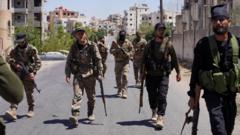
In a bid to calm rising tensions, Syria's interim president, Ahmed al-Sharaa, reaffirmed his administration's commitment to safeguarding the Druze population amidst a backdrop of violent sectarian clashes and Israeli airstrikes in the region. A televised statement from Sharaa declared that the protection of the Druze community was now a priority for the government following Israel's targeted military actions against government forces accused of maltreating Druze citizens in Suweida province.Sharaa's remarks came in the wake of Israeli strikes on Wednesday, which were purportedly aimed at preventing the Syrian government from further threatening the Druze, a religious minority group significant to the region's landscape. According to state media, Syrian forces began to pull back from Suweida, where they had previously been deployed as clashes erupted between Druze militias and Bedouin tribes, resulting in a staggering death toll of over 350 people since Sunday alone.The death toll includes a significant number of Druze fighters and civilians, leading to an atmosphere of fear and uncertainty regarding the government's ability to maintain order. The Druze, distinct for their beliefs which are an offshoot of Shia Islam, have retained a historical distrust of Sharaa due to his association with the jihadist group, Hayat Tahrir al-Sham (HTS).In his reassuring address, Sharaa emphasized the Druze as "a fundamental part of the fabric of this nation" and stated that efforts would be made to protect them from external interference and military coercion. He also asserted that security in Suweida would be enhanced through collaboration with local religious leaders and factions, marking a shift in the handling of security matters.Israeli Prime Minister Benjamin Netanyahu backed military interventions, claiming they were necessary to ensure the safety of Druze citizens and eliminate perceived threats from the Assad regime. Israel’s military emphasized its commitment to preventing hostile elements from establishing a foothold near its border. Meanwhile, U.S. Secretary of State Marco Rubio mentioned that measures are being discussed among involved parties to address the deteriorating situation, while the Syrian Observatory for Human Rights reported increasing numbers of fatalities stemming from the ongoing sectarian strife.The complex dynamics in Syria's civil war continue to evolve, raising concerns about the broader implications for minority communities and regional stability as various factions vie for control and influence amidst the chaos.