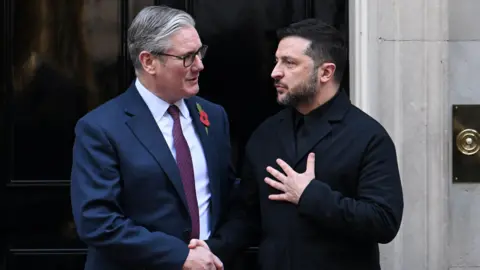
Ukrainian President Volodymyr Zelensky will meet key European leaders in London on Monday, as Ukraine's allies plan their response to an ongoing US push for Kyiv to accept concessions in peace talks.
The leaders of France and Germany will join Zelensky and Prime Minister Sir Keir Starmer at No 10 as they seek to ensure any deal deters a future Russian attack.
The high-level meeting follows three days of talks in Florida, where Zelensky's chief negotiator pushed for changes to a White House plan widely considered to accommodate central Kremlin demands.
The US and Ukraine said there was progress, but US President Donald Trump appeared to criticize Zelensky on Sunday, saying he hasn't read the draft.
Trump told reporters that he was a little disappointed that President Zelensky hasn't yet read the proposal, that was as of a few hours ago.
He continued: His people love it... [Russia] would rather have the whole country when you think of it, but Russia is, I believe, fine with it - but I'm not sure that Zelensky is fine with it.
Trump appeared to refer to the latest draft of the proposed peace deal, revised in Miami following talks led by Zelensky's new chief negotiator Rustem Umerov, and Trump's close aides, special envoy Steve Witkoff and son-in-law Jared Kushner.
Around the same time as Trump's comments on Sunday, Zelensky said he was due to be briefed on the negotiations by Umerov either in London or Brussels, adding some issues can only be discussed in person as opposed to over the phone.
Zelensky added that discussions with Witkoff and Kushner were constructive, though not easy.
Monday's talks in London will feature Starmer, French President Emmanuel Macron, and German Chancellor Friedrich Merz, who represent the three NATO nations with the largest military budgets in real terms, excluding the US.
Downing Street stated that the meeting would focus on the ongoing peace negotiations and next steps, while UK cabinet minister Pat McFadden said it would explore ways to ensure Ukraine is able to decide its own future.
McFadden emphasized the need for meaningful security guarantees in the event of a peace deal, stating it should not be a toothless organization.
The UK and France have led talks to assemble a coalition of the willing, also referred to as the Multinational Force Ukraine, to offer future defense support, possibly including a reassurance force deployed in Ukraine.
It remains unclear what role this force would fulfill, though diplomatic sources have previously indicated it would not be tasked with policing a ceasefire line and would not be classified as impartial.
While Germany and other European defense players, including Italy and Poland, have pledged forms of defense assistance, there is skepticism about the prospects of deploying troops inside Ukraine, given that the Kremlin views such actions as escalation.
The White House has been urging Kyiv and Moscow to swiftly agree on a multi-point plan to end the war.
However, there has been little sign of a breakthrough, including after Witkoff's five hours of in-person talks with Russian President Vladimir Putin in Moscow last week.
Negotiations remain particularly fraught around the issue of territorial concessions, with the US proposing that Ukraine withdraw its forces entirely from eastern regions targeted by Russian aggression, in exchange for Russian withdrawals elsewhere and a ceasefire.
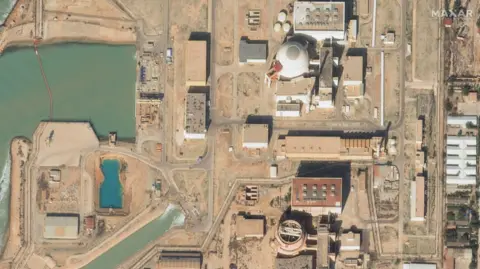
Speaking on Sunday, Trump's outgoing special envoy for Ukraine Keith Kellogg noted that discussions regarding the Zaporizhzhia nuclear power plant are particularly complex, with intense fighting occurring in its vicinity.
The plant, under Russian control, is the largest in Europe, and a leaked draft of the US-backed peace plan suggests splitting its energy output between Ukraine and Russia.
Kellogg remarked that a deal is close, but discussions on these key issues continue, adding: If we can resolve those two matters, I believe the rest will fall into place quite effectively.
The London talks are the latest attempt by Ukraine's European allies to secure a stake in the US-led efforts to end the war, driven by fears that a quick resolution may undermine the long-term interests of Europe.
European leaders have been vocal in their concerns over earlier versions of the US-led peace plan, which has been revised following criticism for being overly favorable to Russia.
Despite facing significant economic pressures and losses on the battlefield, the Kremlin has shown little willingness to compromise on core demands, including a firm rejection of any future NATO membership for Ukraine.
In a related development, Putin reiterated his intention to sustain military operations until Russia gains full control over the Donetsk and Luhansk regions, areas currently held by Russian forces.
Additionally, the Kremlin has responded positively to an updated US National Security Strategy document that emphasizes improving relations between Europe and Russia to mitigate wider conflict risks.