In brief
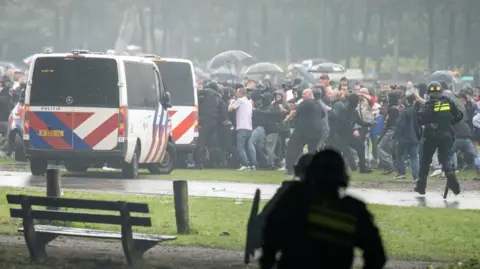
In The Hague, the city was engulfed in chaos as police clashed with approximately 1,500 anti-immigration protesters. The unrest resulted in 30 arrests, several injuries, and widespread condemnation from political leaders, including Prime Minister Dick Schoof and right-wing leader Geert Wilders. Violence escalated as protesters confronted police, leading to damages at a political party's headquarters and a police car being set ablaze.
Dutch police used tear gas and water cannon to disperse violent anti-immigration protesters in The Hague on Saturday.
Thirty people were arrested and two officers injured as large groups of people clashed with police, with some throwing rocks and bottles.
Around 1,500 people blocked a highway crossing the city, while a police car was set on fire, the Netherlands news agency ANP reported, citing police figures.
Prime Minister Dick Schoof condemned the shocking and bizarre images of shameless violence, saying it was completely unacceptable.
Right-wing leader Geert Wilders, who won the previous election in the Netherlands and has retained his lead in opinion polls ahead of a 29 October vote, was invited to speak at the demonstration but did not attend.
Instead, he also condemned the violence against police as utterly unacceptable, saying it was the work of idiots.
The protest was organised by a right-wing activist, demanding stricter migration policies and a clampdown on asylum seekers.
Violence erupted when large groups of protesters, many waving Dutch flags and flags associated with far-right groups, confronted security forces.
Protesters also smashed the windows of the headquarters of the centre-left D66 party, viewed by many on the far right as a party that serves a progressive elite.
D66 leader Rob Jetten said the damage inside was extensive and told the protesters to stay away from political parties.
If you think you can intimidate us, tough luck. We will never let extremist rioters take away our beautiful country, he said on social media platform X.
Nobody was present in the D66 offices at the time of the protests, according to party officials cited by ANP.
The Dutch government collapsed in June after Wilders withdrew his far-right PVV party from the governing coalition following a row over migration.
The dispute came after Wilders pushed for 10 additional asylum measures, including a freeze on applications, halting the construction of reception centres and limiting family reunification.
The governing coalition was in place for less than one year.