
In brief
As South Korea's Seoul High Court reopens the case of Kim Jae-gyu, whose actions led to the assassination of President Park Chung-hee, the nation reflects on themes of power, betrayal, and the quest for democracy amidst a turbulent past.
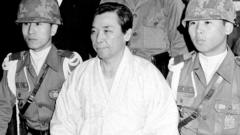
Two gunshots shattered the political landscape of South Korea on the night of October 26, 1979. Yoo Seok-sul, a former security guard from the Korea Central Intelligence Agency (KCIA), vividly recalls the events, detailing how he was ordered to bury the evidence - two guns and a pair of shoes - after the assassination of President Park Chung-hee, executed by his trusted associate, Kim Jae-gyu. This incident transformed South Korea’s political fabric, abruptly ending Park’s 18-year authoritarian rule, and leading to Kim's execution for insurrection alongside five others.Decades later, Kim's legacy is now under scrutiny as a retrial begins to determine whether his actions constituted treason. Divided opinions continue to swirl around Kim - regarded by some as a misguided hero fighting for democracy, while others label him a power-hungry traitor. The climate around this retrial is charged, especially as it coincides with the impeachment trial of current president Yoon Suk Yeol, reminiscent of the chaos surrounding Park’s regime.Glimpses into the assassination reveal Kim’s motives were intertwined with deep-seated tensions within the government. Despite shared beginnings with Park, Kim's relationship deteriorated as Park further consolidated power, leaving no room for dissent. Reports suggest Kim had contemplated the assassination multiple times, motivated by an urge to prevent further bloodshed amidst political unrest. Yet many question whether this act was premeditated or a spontaneous outburst in a moment of weakness.As the trial unfolds, the legitimacy of the original military court proceedings is being challenged. Advocates for Kim argue that his case was marred by torture and a lack of fair representation during the initial trial. Legal experts assert that for Kim to be convicted of insurrection, concrete proof of his intentions to seize state control must be established. This retrial, thus, serves as more than a legal proceeding; it is a moment for South Koreans to confront their past and reflect on the complex legacy of Park Chung-hee's rule and the violent methods employed to challenge it. The outcome may influence how history views Kim Jae-gyu, prompting a reevaluation of whether he acted as a patriotic hero or a traitorous assassin in the name of a higher cause.